




Have you ever looked at your coffee table and thought something about it just didn’t look quite right, but you couldn’t figure out why? Or maybe you were hanging a light fixture above a table and suddenly realized you had no idea how high it should go.
Decorating is part creativity and part know-how. You get to choose the colors, the furniture, and the overall look of a room, but there are also a handful of tried-and-true measurements that help everything feel balanced.
A coffee table that’s slightly too tall, artwork that’s hung a little too high, or curtains that stop just short of the floor can make a room feel not quite right, even when everything else looks good.
The reason designers seem to get these details right so often is because they rely on a few standard decorating measurements. Once you know them, decorating becomes a lot easier.
Think of the list below as a cheat sheet of measurements that help rooms look polished and well-proportioned.
Why Decorating Measurements Matter
When something in a room feels off, it’s often not the furniture or the decor itself. It’s the proportion or spacing between things.
A rug that’s too small can make a seating area feel disconnected. Artwork that’s hung too high can make the wall feel awkwardly empty. And a chandelier that’s the wrong size can throw off the balance of the entire room.
These little details may seem minor, but they make a big difference in how a space feels.
Designers rely on a handful of standard decorating measurements to help rooms look balanced and comfortable. They’re not strict rules, and every home is a little different, but they’re incredibly helpful guidelines when you’re trying to figure out placement, spacing, or scale.
Once you know these measurements, decorating becomes a lot less guesswork and a lot more confidence.
Living Room Decorating Measurements
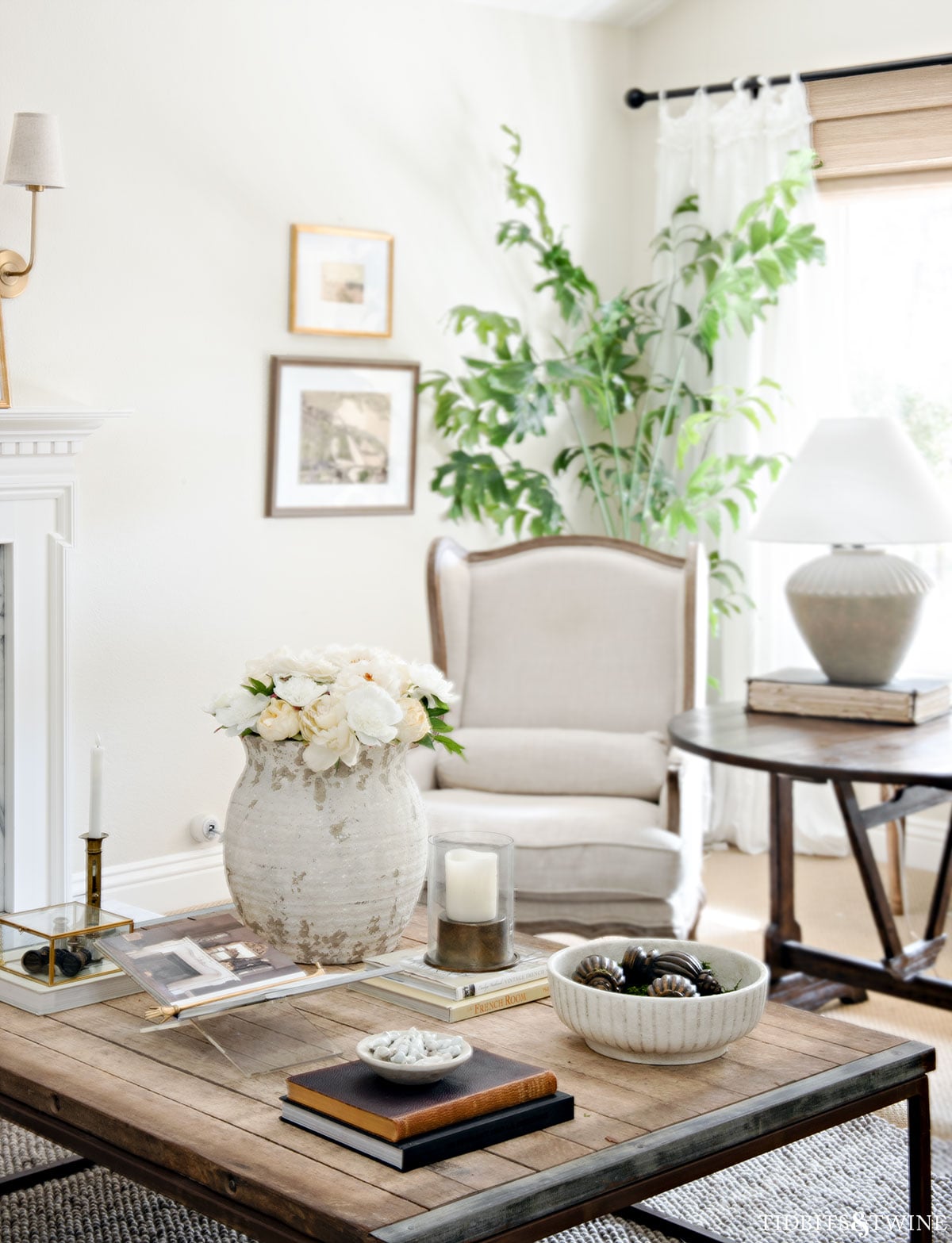
The living room is one of the places where decorating measurements really matter because there’s usually a lot of furniture and wall space to fill. Coffee tables, side tables, rugs, and seating all need to be the right size and spacing for the furniture around them, and even small differences in height or spacing can change how the room feels.
Here are a few helpful measurements that designers commonly use when planning a living room.
• Walkways: Leave 30″–36″ for a comfortable pathway through a room, or 36″–48″ if you want the space to feel more open and airy.
• Area rugs: In a living room, the rug should anchor the seating area, usually with at least the front legs of the sofa and chairs sitting on the rug. If the rug fills most of the room, leave about 12″–18″ of floor visible between the rug and the wall (or 8″–12″ in smaller rooms).
• Side tables: Choose tables about the same height or up to 2″ lower than the sofa arm so they’re easy to reach.
• Coffee tables: A coffee table should be about the same height or 1″–2″ lower than the sofa seat cushion.
• Coffee table spacing: Leave 14″–18″ between the sofa and the coffee table so people can walk through comfortably.
• Coffee table size: Ideally a coffee table should be about ½ to ⅔ the length of the sofa.

Not sure what size coffee table to buy? See my full guide to choosing the right coffee table size for easy measurements and layout tips.
Wall Decor Measurements
Wall decor can be surprisingly tricky. A piece of art that’s slightly too small or hung just a little too high can make a wall feel awkward even if the artwork itself is beautiful. These measurements help keep artwork looking balanced with the furniture and walls around it.
• Artwork height: In most rooms, artwork looks best when the center of the piece is placed about 57″–60″ from the floor.
• Artwork above furniture: When hanging art above a sofa, console, or dresser, leave about 6″–10″ between the bottom of the artwork and the top of the furniture.
• Artwork width above furniture: Artwork above a sofa or console should generally be about 60%–75% of the width of the furniture below it.
• Gallery wall spacing: When grouping multiple pieces of artwork together, leave 1½”–2″ between frames so the arrangement feels cohesive.
Wondering exactly how high to hang pictures?
See my full guide on how to hang artwork at the right height for step-by-step guidance and examples.
Dining Room Measurements
Dining rooms have their own set of measurements that help everything feel comfortable and balanced. Table height, seating space, lighting placement, and wall details all play a role in how the room functions and looks.
Here are a few helpful guidelines to keep in mind when planning a dining room.
• Dining table height: Standard dining tables are usually about 30″ high.
• Table clearance: Leave 36″–48″ between the edge of the table and the wall or other furniture so chairs can slide out comfortably.
• Dining chair height: Dining seating is typically 16″–18″ from the floor to the top of the seat.
• Table space per person: Allow about 18″ of table width per person so everyone has enough elbow room.
• Chair spacing: Leave about 24″–30″ between the centers of dining chairs so guests can sit and move comfortably.
• Table length: As a general guide, a 48″ table can seat about 4-6 people, 72″ can seat 6-8, and 96″ can seat 8-10, depending on chair size.
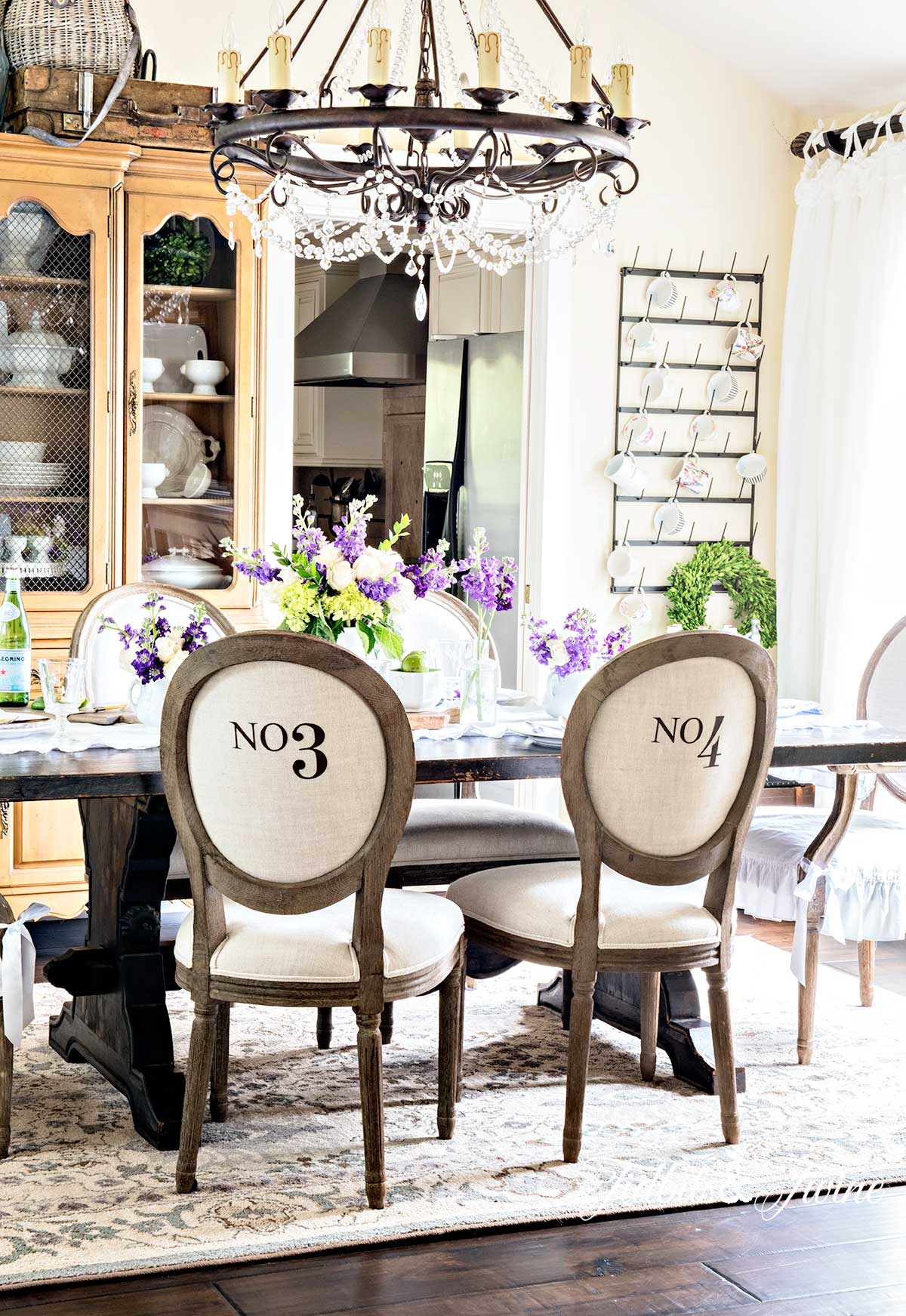
• Chandelier size: To estimate chandelier diameter, you can either divide the width of the dining table by two or add the room’s length and width in feet to get the chandelier diameter in inches.
• Chandelier height: Chandeliers should typically hang 30″–36″ above the dining table surface. Click HERE for more details.
• Chair rail height: Chair rails are usually installed 34″–36″ above the floor.
• Wainscoting height: Wainscoting is often installed 36″–48″ above the finished floor, depending on ceiling height and room proportions.
• Wall sconces: In most rooms, center the sconce backplate 60″–64″ above the floor.
Bedroom Decorating Measurements
Bedrooms are usually simpler to plan than living rooms, but a few measurements can make the space feel much more comfortable. Nightstand height, lighting placement, and rug size all play a role in how balanced and functional the room feels.
Here are some helpful bedroom measurements to keep in mind.
• Nightstand height: For most beds, 24″–27″ is an ideal nightstand height, or roughly the same height as the top of the mattress.
• Nightstand width: For a king-size bed, nightstands should generally be at least 36″ wide so they don’t look undersized next to the bed.
• Bedside table lamps: The bottom of the lampshade should be about 20″ above the top of the mattress so the light falls comfortably for reading.
• Swing-arm bedside lamps: Mount swing-arm lamps no more than 3″ out from the edge of the headboard, with the bottom of the shade about 20″ above the mattress.
• Headboard height: Use a 47″ headboard if you don’t want much of it visible above the pillows, or 52″ or taller if you want more headboard showing.
• Benches or trunks at the foot of the bed: These should be slightly lower than the height of the bed and typically 15″–21″ deep.
• Area rugs under beds: Rugs should extend 6″–12″ beyond the outer edges of the nightstands and the foot of the bed.
Window Treatment Measurements
Curtains can dramatically change how large a window appears. Hanging them higher and wider than the window frame helps elongate the wall and makes the room feel more finished.
Here are a few helpful measurements to keep in mind when choosing curtains and curtain rods.
• Curtain fullness: Curtain panels should be at least twice the width of the window for proper fullness. In more modern rooms, 1¾ times the window width can create a sleeker look.
• Curtain rod width: Extend the curtain rod 6″–8″ past the outer edge of the window trim on each side so the curtains frame the window instead of covering the glass.
• Curtain rod height: Hang curtain rods as close to the ceiling line as possible to visually elongate the window.
• Curtain length: Curtains should typically just touch the floor or hover about ½” above it. For a more dramatic look, allow 2″–8″ of extra length so the fabric gently puddles.
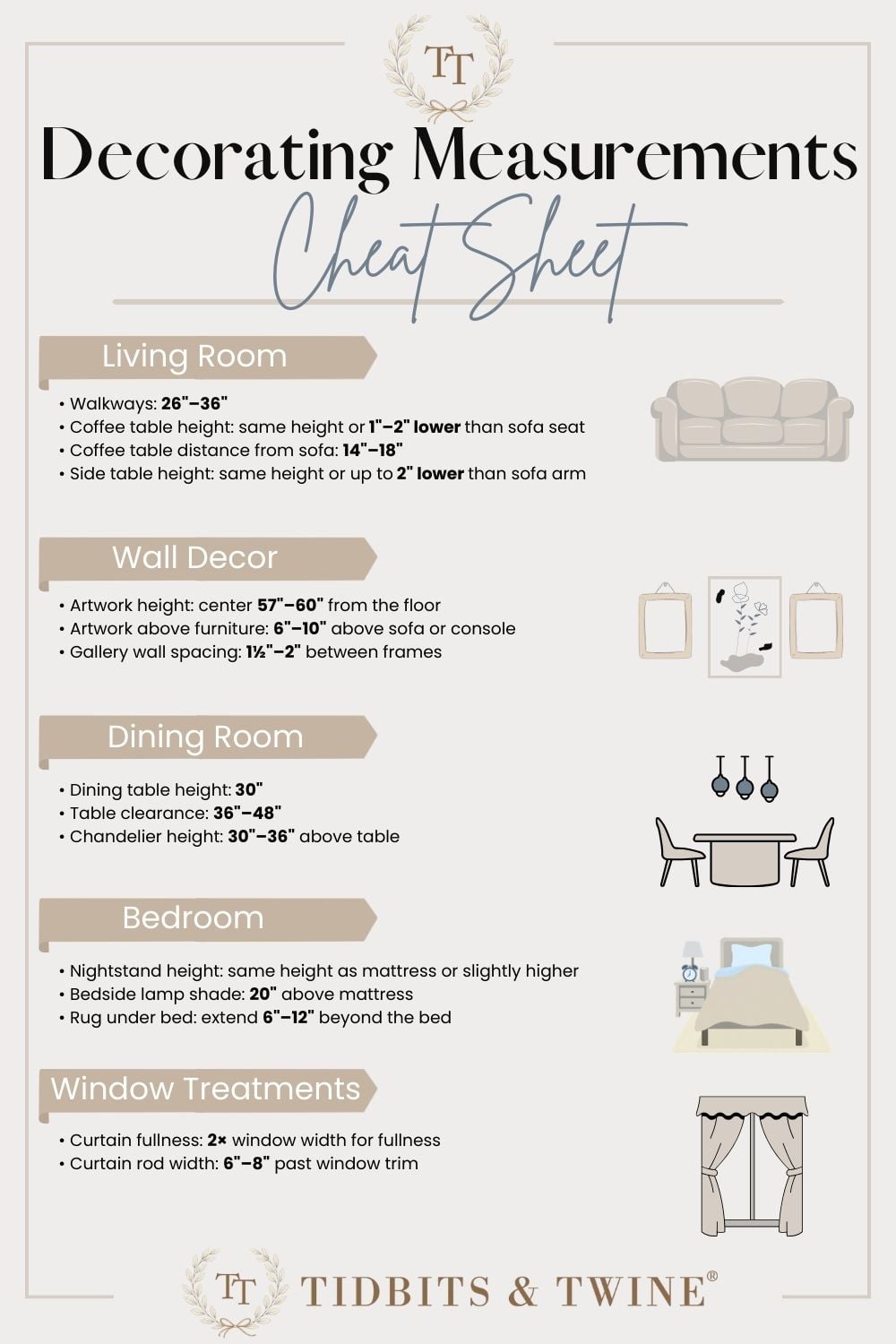
Decorating Measurement Cheat Sheet
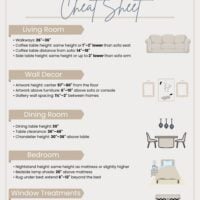
If you want a quick reference, here are some of the most common decorating measurements designers rely on.
More Decorating Measurements
Looking for more decorating measurements? I also have guides for bathroom layouts, lighting placement, and rug sizing that walk through additional rules designers use.
- How to choose the right coffee table size – for coffee table proportions, spacing, and sizing guidelines
- How high to hang pictures – for artwork height, spacing, and placement above furniture
- How high to hang a chandelier – for chandelier height and dining room lighting placement
- Nightstand dimensions – for choosing the right nightstand height and width
- How to choose the right rug size – for living room, dining room, and bedroom rug guidelines
- Bathroom measurements guide – including how high to hang a shower head and the right spacing for sconces
So does this mean that if you aren’t following these decorating measurements your design is wrong? Of course not! If it feels good to you and you like how it looks, that’s all that matters. But if you’re unsure as to where to begin, these measurements provide a good starting point.
I hope you find these decorating measurement guidelines as useful as I have!

Like this? Then you might also like:

I have a 14’ x 14’ bedroom with 8’3” ceilings. My question is… what height do you hang a chandelier when it is over the bed? To complicate things, I have a Queen size bed with 4 posts connected by canopy bars. The chandelier hangs dead centre width wise and about 23” in from the end of the bed. I put it up closer to the ceiling but I didn’t like it.
Is there a rule…. like when you hang one over a table or anything?
It’s the canopy rods that bother my eye when they visually cross through the light.
Thx! Jodie. :)
P.S. Great info otherwise!!
Hi Jodie – The standard (general guideline) for a chandelier hanging above a bed or just over open floor space, is 7′ from the floor to the bottom of the chandelier. I hope that helps!! :) Kim
These are grand for 8′ ceilings but more and more have 10′ and 11′ ceilings in homes.
Would love revisions for those heights.
I know that seat height should match in a living room- does the height of the arm rests also need to match on an accent chair (it is a small room and is at a 90 degree angle to- and nearly touching- the couch)? Thank you!
Trying to decorate a small table top. How much of the table should be taken up with decorating accessories? And how high should they be?
We’re buy home and could use some suggestions on how to make most of living room. Windows on 2 walls kitchen island on other and wall leading into space from door. Windows have beautiful view of ponds and husband wants furniture to face tv and Windows .help
My bedroom is very narrow. I have had to put my king size bed and two nightstands on the end wall that has two windows. Bed is between windows. Headboard is about 8″ into each window. I do not have a wall large enough to fit all three pieces on. How can I best use drapes?
Hi Jennae-I love your blog! What a timely post for me since we’re in the market for a new couch.
My main concern is the cushions (I really want all natural latex) and I don’t want flame retardants or stain guards on anything.
I’ve been thinking of buying/finding a used couch and stripping it down to the frame, purchasing those natural latex cushions I want and ordering a custom made slipcover for the whole thing. After pricing out the cushions, it’ll still be pricey, but better than a new one.
Do you know of anyone who’s ever done such a thing?
I wonder if I’m crazy, or if it’s a good way (although time and labor heavy,) to get the sofa I’m looking for at a more reasonable price.
Thanks for the post!
thanks for your tips
could you also give me some idea for the reasonable height of bed and mattress please?
How far can the nightstand be from the bed?
i have a small breakfast table with tiny chairs that are 15″ depth. I found chairs that I love that are 18.5 deep but 20″wide and my current chair are only 15″ wide. So if I bought the new chairs they wouldn’t push into the pedestal table. How far back should to the front part of the back of the chair be from the apron of the table?
Hi Amy –
In my opinion, the distance between your table apron and chair back depends on 1) your space 2) how often the chairs get used and 3) your decorating style, in that order. If the space around your table is restricted, you’ll want to ensure that your chairs push in as much as possible so that you don’t restrict the flow of traffic. If space isn’t any issue, then how far out the chairs sit from the table is a matter of personal preference. If they are pushed in tightly, they have a more formal feel – pulled back a bit they have a more relaxed look. In my own home, I have a more casual look so my dining chairs tend to be pulled away from the table anywhere from 4″ – 10″. (4″ in the dining room, 10″ in the kitchen.) The key, though, is to not have the chairs sit so far away from the table that they look pulled out. In general, I determine this by seeing whether someone could sit down without moving the chair. If you can, the chair is pulled out too far. I hope that helps!
What the best decor to get sold asap.
Kim, thank you for the great tips. They will come in handy when decorating our new home. I do have a question I didn’t see an answer to…in a bedroom with 10ft ceilings where I’d like the headboard to be the focal point, how tall should the headboard be? Thank you.
Hello! I was wondering what is the standard “rule of thumb” for the length and width of a leaning wall mirror? I plan on putting a wall mirror in my master bedroom. I have seen one that is 88″ high and 16″ wide. I feel this is too high. My walls are standard height with a tray ceiling. I was thinking 65″-72″ . What do you recommend? Thank You.
Hi Janice – I don’t know that I’ve ever come across a rule of thumb for the height of a mirror. I have a few in my own home and I usually choose the height based other elements nearby. For example, in my bedroom and living room, my wall mirrors are roughly the height of my windows so that they essentially act as another window in the space and help provide a constant height around the room. I also have two flanking a fireplace and I wanted them to be shorter than the mantel decor so as not to detract from it. I guess what I’m saying is that you should look in your space to see how high the windows are {or the window treatments would be an option, too}, other wall decor, fireplace decor, etc. and choose something that fits well with what you already have….unless, of course, you want the mirror to be a focal point in which case it would be fine if it’s taller than everything else!
I’m sorry that I can’t provide you with a more specific answer but I hope that helps! :) Kim
You mentioned how deep a bench in front of a bed should be, but how wide should it be? 48″ for a Queen? 60+ for a King? I’ve also heard 2/3s of the width of the bed. Any thoughts?
Hi Joe – My personal preference is about 12″ less than the width of the bed, but depending on the shape of the bed frame and of the bench, sometimes they look good even when they are both the same width! At a minimum, though, I think it should be at least 2/3s {anything less and the scale starts to look disproportionate}. So a 60″ queen-sized bed would have a bench that is no less than 40″, but closer to 48″ +/-. Does that make sense??? :)
Awesome! That makes perfect sense. Thanks!
Good grief! I forgot the most important thing! Great post! I pinned it for reference and will be referring to it. I can say with certainty I’ll be using this info as we get settled into our new home. Thanks for this!
Thank you! :)
designers disagree about curtain length whether to puddle or not, but just make sure they aren’t too short, the equivalent of a high water pair of jeans.
You didn’t include an important one – not hanging a piece of art too high off the back of a couch so there’s a big gap between the couch and the bottom of the art. (Typically should be 8″-10″) Also, did you include the guideline for height of art on a wall? (60-65 inches from floor to center of the art) I was at a friend’s, and she’d hung her family photos in a row along the hall above my head. I kid you not. They were like a wallpaper border rather than an arrangement of photos. Hanging too high is a common mistake.
All great tips, Gael! Thanks for sharing! :) Kim
Comment
Where did you get the sectional sofa? How is it holding up?
Ok, this page is pretty important but I don’t want to print 22 pages!!. Can’t you make a link to a pdf that just has the measurements and room without the pictures?
Wow! 22 pages, huh? I guess that post was longer than I realized!! My suggestion would be to highlight the text you want and copy (Ctrl+C) and paste (Ctrl+V) it to a Word document that you can print or save as needed. I’m glad you found the info helpful, though! :) Kim
Or, just create a pin out of it and put it on one of your Pinterest boards. That’s what I did!
I always wonder how long the curtains should be and what the rules are here. Any thoughts?
Hi Jessica – Sorry for the delayed response! I’m still playing catch-up after taking some time off to hang with the kids. To answer your question, I feel that curtains should be hung as close to the ceiling or crown moulding as possible in order to help elongate the look of a room. If you don’t have crown, consider 1″-2″ below the ceiling. If you have crown, try mounting the rod directly underneath it. Then measure that distance from the rod to the floor to get your total length (be sure to account for the type of header your are using, as this will affect the location from where your drape actually starts in relation to the rod). If you want a puddled look, add anywhere from 2″-8″ to the total length depending on your preference.
These are the basic guidelines I tend to follow. I hope that helps!! :) Kim